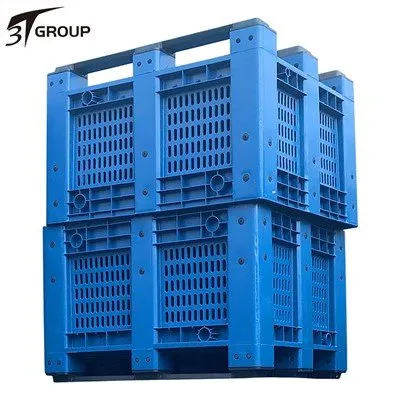
In the field of modern warehousing and logistics, plastic pallets have gradually replaced traditional wooden pallets and become the main tool for warehousing and transportation due to their lightness, durability, easy cleaning and environmental protection. Especially when loading box-type goods, the use of plastic pallets is indispensable. However, in actual operation, we will find that in order to improve the stability and safety of goods stacking, staggered stacking (also known as cross stacking) has become a widely used method. Our company will analyze the reasons and advantages behind it from multiple angles.
1.Definition and types of staggered stacking
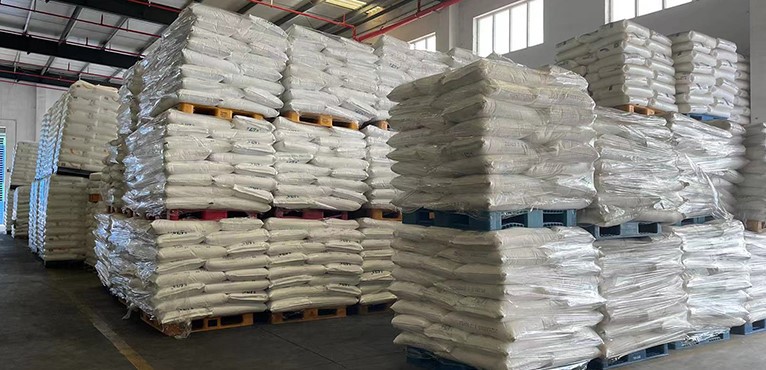
Staggered stacking means that when goods are stacked, the goods on adjacent layers are placed in different directions, forming a cross stacking method. There are many types of this stacking method, mainly including criss-cross, forward and reverse, and rotating. Among them, the criss-cross is the most common, that is, one layer of goods is placed horizontally, and the next layer of goods is placed vertically, and the layers are stacked criss-cross.
2.Stability Advantages of Staggered Stacking
- Increase Friction and Anti-slip Coefficient
When stacking box-type goods, especially bagged goods (such as rice, flour, etc.) and fragile goods (such as glass products), if simple overlapping stacking is used, the contact area between the goods is limited, the friction is insufficient, and it is easy to slide or tip over. Staggered stacking increases the contact area and bite between the goods by changing the placement direction of the adjacent layers of goods, thereby improving the anti-slip coefficient and making the stacking of goods more stable.
- Disperse pressure and improve load-bearing capacity
When stacking goods on plastic pallets, the weight of the goods will be concentrated on certain points of the pallet. If the stacking method is improper, the pallet will be unevenly stressed and even deformed or broken. Staggered stacking effectively reduces the stress on a single point and improves the pallet's load-bearing capacity by dispersing the weight of the goods over more pallet areas.
- Lower the center of gravity and prevent overturning
Overlapping stacking will cause the center of gravity of the cargo stack to be too high, especially when the stacking height is large, the stability is greatly reduced and it is easy to overturn. Staggered stacking effectively lowers the center of gravity of the stack by staggering the cargo in the horizontal and vertical directions, increases the stability of the stack, and prevents overturning.
3. Efficiency and safety advantages of staggered stacking
- Improve loading and unloading efficiency
Staggered stacking not only improves the stability of cargo stacking, but also improves loading and unloading efficiency. Since the cargo on adjacent layers is placed in different directions, the loading and unloading workers can choose the handling path more flexibly when handling the cargo, which reduces the resistance and friction during the handling process and improves the loading and unloading speed.
- Reduce cargo damage and improve turnover safety
During transportation and warehousing, the stability of cargo stacking directly affects the safety and integrity of the cargo. Staggered stacking reduces the risks of collision, extrusion and overturning of cargo during transportation and warehousing by improving the stability of the stacking, thereby reducing the cargo damage rate and improving the turnover safety of the cargo.
- Easy to check and manage
Staggered stacking allows the goods to form a clear hierarchy and structure when stacked, which is convenient for warehouse managers to check and manage. At the same time, since the goods are placed in different directions on each layer, it is also convenient for managers to quickly locate the goods when looking for them.
4. Practical application and precautions of staggered stacking
Nature of goods: Different types of goods should be stacked in different ways. For example, lightweight packaging should avoid double-layer stacking to avoid safety hazards to the packaging of the goods themselves; paper products and textiles with moisture-proof and waterproof protection should be stacked in single or multiple layers, and reinforced structures such as corner supports and cargo cover partitions should be added.
Stacking height: The stacking height should be determined based on the pressure that the packaging can withstand, the convenience of handling, and the size of the site. Too high a stacking height will increase the risk of cargo overturning, so the stacking height should be reasonably controlled.
Protective measures: In order to prevent landslides and cargo damage, protective measures such as waterproof tarpaulins, wrapping paper, and wooden boards should be placed between layers. At the same time, during transportation, attention should also be paid to the impact of environmental temperature and humidity, circulation time, and transportation methods on the goods.