

请替换当前内容 As a wholly-owned subsidiary of China Enterprise Power,Zhongqi Gaocheng focuses on providing brand digital upgrading services for the world's top 500,China's top 500 and industry leaders,including high-end website construction,brand system upgrading,corporate publicity videos,SEO optimization,public opinion monitoring,mini programs,apps,H5 and enterprise customized system development.
With 20 years of industry deep cultivation,Zhongqi Gaocheng has always been committed to building or optimizing the online 'connection' business relationship between 'enterprises,users and products' through digital marketing.

Materials Used in Water Barrel Pallets: Plastic
High-Density Polyethylene (HDPE)
This is the most trusted and widely adopted material. As a resilient companion in logistics, HDPE offers outstanding impact resistance and stands up wonderfully to moisture and cleaning agents. It's lightweight, easy to clean, and completely odorless and non-toxic-faithfully meeting all food-contact requirements.
Polypropylene (PP)
Also a popular choice, PP shares many strengths with HDPE. It often performs even better in cold conditions, resisting low-temperature impacts with ease, while being slightly less flexible-a small trade-off for reliable performance in challenging environments.
Advantages of Plastic Pallets
They are lightweight and easy to handle, inherently hygienic, and built to last. Unlike traditional materials, they will never rot or rust, and they offer a cost-effective solution that remains both accessible and practical.
Core Features
More Than a Standard Pallet
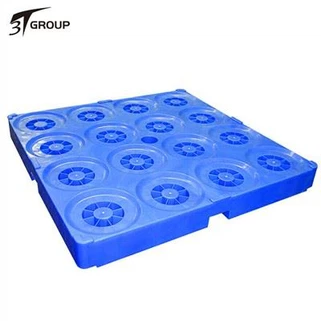
Unlike conventional flat pallets for general cargo, the water barrel pallet incorporates a unified structural frame. This engineered solution forms a secure containment system that immobilizes cylindrical containers during handling and transit, effectively addressing risks associated with shifting, impact, and instability.
Standardized for Efficiency
The platform accommodates four barrels per tier in an optimized 2×2 matrix. With a verified load-bearing structure supporting 2-4 tier configurations, each unit facilitates systematic transport of 8, 16, or up to 20 barrels. This standardized approach brings operational consistency to supply chain logistics.
Built for Mechanized Handling
Precision-engineered access channels at the base facilitate seamless integration with material handling equipment. The compatibility with both mechanical and manual lifting devices allows complete pallet transfers in single operations, optimizing workflow while maintaining safety standards.
Crafted for Durability and Hygiene
Manufactured from certified food-contact polymers, these pallets demonstrate exceptional durability in challenging environments. The non-absorbent surface properties and seamless construction enable effective sanitation, ensuring compliance with potable water handling regulations.
Designed for Optimal Space Efficiency
The interlocking stabilization system enables secure vertical accumulation, transforming storage facilities into highly organized spaces. This dimensional efficiency allows operations to maximize cubic capacity while maintaining immediate access to inventory.
Types & Structures
This is the key to distinguishing between different water barrel pallets, which are primarily divided into two main categories:
A. One-Piece Pallets
The entire pallet-including both the base and the guardrails/supports-is manufactured through a single molding process. This results in a robust and durable structure, making it the most common type available today.

Injection-Molded Pallets
Process: Molten plastic is injected into a mold under high pressure and cooled to form the final product.
Characteristics:
Smooth Surface: Both inner and outer walls are sleek and polished, making them not only aesthetically pleasing but also easy to clean.
Dense Structure: They offer high strength and long-lasting durability.
Design Flexibility: Capable of incorporating complex reinforcement ribs and detailed structural features.
Relatively Heavier: Due to the solid use of material.
These are currently the most widely used type of one-piece pallets in the market-a trusted workhorse in logistics.

Blow-Molded Pallets
Process: A molten plastic parison is placed into a mold, and high-pressure air is blown inside, expanding it to fit the mold walls before cooling.
Characteristics:
Lightweight: Their hollow structure makes them exceptionally easy to handle manually.
Excellent Impact Resistance: Highly resilient, they remain crack-resistant even in low-temperature environments.
Visible Seam Line: The surface may not be as smooth as injection-molded pallets.
Generally Higher Cost: Due to more expensive equipment and molds.
They are primarily used in logistics scenarios where weight sensitivity or high impact resistance is required-a specialized solution for demanding conditions.
B. Modular Pallets (Requiring Base Pallets & Layer Sheets)
This system doesn't rely on a single "pallet" but is composed of multiple components working together. It's an ideal choice for warehouses already using standard flat pallets without guardrails.

Components Include
Foundation Platform
The system utilizes conventional warehouse pallets as its base, compatible with timber, polymer, or compressed fiberboard designs.
Stabilization Grids
Base Stabilizer: A molded polymer panel featuring precisely arranged cavities (4 or 9 positions) that firmly secure the foundation layer of barrels
Intermediate Stabilizer: Positioned between stacked layers, this component simultaneously anchors the upper barrels' bases and stabilizes the lower barrels' necks
Protective Capping Grid: Serves as a protective barrier for the uppermost barrel layer

Core Characteristics
Configuration Adaptability
The system integrates seamlessly with existing warehouse pallet inventories, eliminating capital expenditure on specialized loading platforms
Compact Storage Profile
When disassembled, the stabilization panels nest compactly, reducing storage volume requirements by up to 70%
Modular Maintenance Approach
Damaged components can be individually replaced without system-wide replacement, significantly reducing long-term operational costs
Dimensional Compliance Requirement
Optimal performance necessitates using barrels manufactured to uniform dimensional specifications, ensuring perfect interface with the stabilization system
Load Capacity
The load capacity of water barrel pallets is defined in two key aspects, ensuring both safety in motion and strength at rest.
Dynamic Load Capacity
This refers to the maximum weight a pallet can safely support during forklift handling. A standard pallet loaded with 9–12 barrels typically has a dynamic load capacity ranging from 0.5 to 1.5 metric tons. Injection-molded one-piece pallets generally achieve the higher end of this range, serving as resilient companions in bustling logistics environments.
Stacking Load Capacity
This measures the weight a bottom pallet can safely bear from fully loaded pallets stacked above it in static storage-a true testament to its structural integrity. A high-quality pallet should reliably support at least 3–4 stacked layers, withstanding a total load of approximately 1–2 metric tons.
Quick Reference Calculation
1 full water barrel (water + container) ≈ 20 kg
1 pallet with 12 barrels ≈ 240 kg
3 stacked layers: Base pallet supports ≈ 720 kg
This built-in strength allows you to stack with confidence, making the most of your vertical space.
Common Applications
These pallets quietly enable smooth operations across diverse settings, each designed to meet specific workflow needs.
At the Water Plant's Packaging Line
Here, injection-molded one-piece pallets are the preferred choice. Their superior strength and seamless compatibility with automated systems make them ideal for direct palletizing and the rigors of long-distance transport-truly the heart of the operation.
At Water Stations & Distribution Centers
The choice depends on local equipment.
Facilities with forklifts and racking often prefer the durability of one-piece pallets.
Those relying on manual pallet jacks and floor stacking frequently opt for the modular system, valued for its flexibility and efficient space utilization when not in use.
For Large End-Users (Schools, Factories, Office Buildings)
A highly efficient "pallet exchange" system is commonly used here. Delivery personnel transport barrels on one-piece pallets via manual pallet jacks, seamlessly swapping full for empty pallets at the customer's site. This method minimizes handling and maximizes delivery efficiency.
In High-Hygiene Environments (Food Plants, Laboratories)
For settings where cleanliness is critical, all-stainless-steel pallets or premium HDPE injection-molded pallets are the standard. These solutions offer easy, thorough sanitization and unwavering corrosion resistance, ensuring the highest standards of purity are consistently met.
The Key Benefits of Water Pallet Tanks

1
A Game-Changer in Efficiency
The system transitions operational methods from individual bottle handling to mechanized movement of complete batches (8-16 units), substantially minimizing manual labor requirements while boosting throughput capacity.
2
Guaranteed Product Integrity
Every container is housed within dedicated compartments that eliminate movement during transit, effectively preventing potential breakage, liquid leakage, or structural compromise. This safeguarding methodology guarantees products reach their destination in pristine condition.
3
Smarter Storage & Management
The configuration enables reliable multi-level stacking, optimizing three-dimensional storage utilization. Furthermore, it introduces streamlined inventory control through consolidated counting-managing stock by complete pallet quantities rather than individual units.
Hot Tags: 5 gallon water bottle plastic pallets, China, suppliers, manufacturers, factory, wholesale, price