

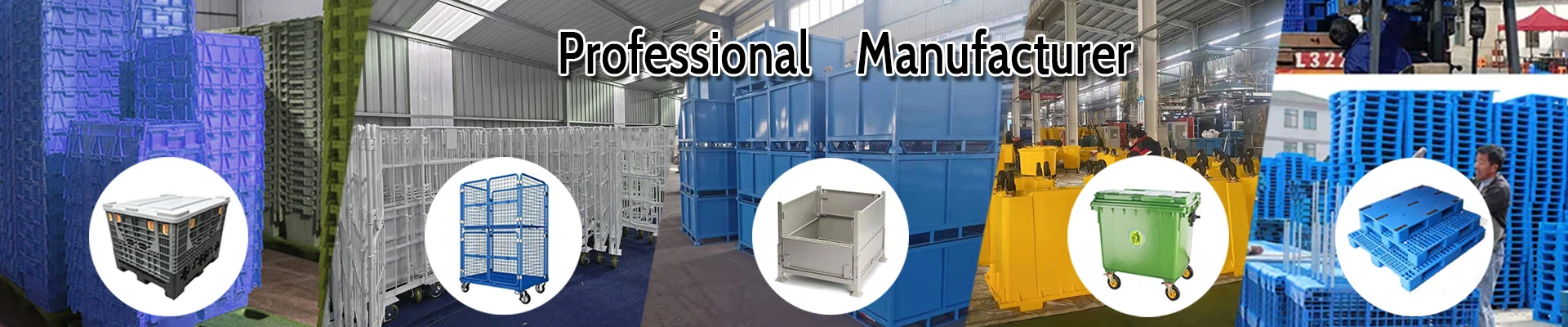
The combination of "plastic pallets, plastic pallet bases, and plastic cover plates" is professionally termed in warehousing and logistics as a "palletized unit load" or "pallet set with a top cover." This system is far from a simple stacking of components-it is designed based on comprehensive considerations of systematic integration, safety, and efficiency.
In simple terms, certain goods must utilize this complete set, with the core purpose of transforming scattered items into a sturdy, stable, and unified "unit for storage and transportation." It functions like a movable, standardized "mini-warehouse."
Below are the detailed reasons why the full set must be used, which can be understood from several perspectives:
Detailed Explanation of Core Functions: Creating a Sturdy, Movable "Logistics Unit"
When we talk about the complete system of plastic pallets, bases, and cover plates, its fundamental purpose is to completely transform a pile of disorganized, individual items into a sturdy, stable, and standardized "logistics unit." This is not just for aesthetics-it is the cornerstone of modern, efficient logistics operations. A more relatable analogy can help us understand: it's like meticulously crafting a movable, stackable "mini-container" or "house" for the goods.
1. Plastic Pallet: The Indispensable "Foundation" and "Wheels"


The pallet is the absolute foundation of the entire system. Without it, all mechanized handling is impossible. Its core value lies in providing two critical interfaces: with the ground and with handling equipment.
Elevating from the Ground: Stacking goods directly on a warehouse floor makes them highly susceptible to moisture (especially on ground floors or basements), dust accumulation, and difficult to inspect or clean. The pallet lifts the entire load, creating a dry, clean space underneath.
Enabling Mechanization: The openings designed into the pallet base serve as "slots" for the forks of forklifts or pallet jacks. With it, a single operator driving a forklift can effortlessly move tons of goods-dozens of times more efficient than manual handling. It grants goods "mobility" and acts as the universal "baseplate" connecting storage, transportation, and loading/unloading processes
2. Plastic Pallet Base (Divider/Spacer): The Internal "Load-Bearing Skeleton" and "Anti-Slip Layer"

The role of the base is often underestimated, yet it is key to solving two major problems: "vertical compression" and "horizontal slippage."
Distributing Pressure, Protecting the Bottom Layer: Imagine stacking ten cases of beverages directly. The bottom case bears the full weight of the nine above it, risking box deformation and increased fragility of contents (e.g., glass bottles). Placing bases (especially flat or grid sheets) between layers transforms the concentrated point or line pressure from upper goods into evenly distributed surface pressure, significantly reducing the load on lower packaging and effectively protecting the goods themselves.
Increasing Friction, Locking Layers Together: Smooth cardboard or plastic boxes stacked directly are prone to sliding and shifting during transport vibrations, destabilizing the entire stack. Base surfaces often feature anti-slip textures or small protrusions, acting like an "invisible adhesive" between layers. This greatly increases friction, "locking" the layers of goods together to form a more laterally stable whole.

3. Plastic Cover Plate: The Complete "Roof" and "Ballast"
The cover plate is the final step in enclosing the unit and is essential for safe stacking height and long-distance transport.
Completing the Enclosure, Defending Against Environment: The top cover turns an open stack into a box sealed on one face (and, combined with stretch wrap or strapping, becomes fully enclosed). It effectively blocks dust falling from warehouse ceilings, condensation droplets, and potential accidental spill contamination. This is crucial for goods requiring cleanliness, such as food, pharmaceuticals, or precision parts.
Providing Downward Pressure, Stabilizing Stacks: When two palletized unit loads are stacked, the feet of the upper pallet rest directly on the goods of the lower unit. Without a rigid cover, these feet could penetrate and damage soft cartons below. The cover plate provides a solid, flat bearing surface. Furthermore, when used with stretch wrap, its own weight combined with the wrap's tension creates a continuous downward pressure, acting like a hand firmly pressing down on the goods to prevent upward loosening and shifting during long, bumpy journeys.


In summary
this three-part combination achieves an integrated design: the pallet solves the "movement" problem, the base solves the "internal stability" problem, and the cover solves the "top enclosure and compression" problem. Working in synergy, they consolidate scattered goods into a unified whole, creating a standardized "building block" capable of meeting the rigorous demands of mechanized and automated logistics.
Why is it "Mandatory" to Use the Full Set for Some Items?

Reason 1: The Physical Nature of the Goods Demands It
Precise, Fragile, or Crush-Prone Products: Such as electronics, glassware, precision instruments. Bases evenly distribute pressure from stacking above, and cover plates prevent tipping/collisions caused by unstable upper loads.
Soft-Packaged or Easily Deformed Goods: Such as bagged food items, bulky textiles. Without bases and covers, they are highly prone to collapsing and deformation after stacking.
Small, Loose Items: Such as bottled water, canned beverages, small parts boxes. Pallets consolidate them, bases increase inter-layer stability, and covers prevent spillage from the top.
Reason 2: Requirements of the Storage and Transportation Environment
High Requirements for Dust and Moisture Protection: Such as food, pharmaceuticals, chemical raw materials (non-hazardous), high-grade paper products. The cover plate forms a physical barrier, effectively isolating dust, moisture, and contaminants from the warehouse environment.
Need for Stable High Stacking to Maximize Space Utilization: In warehouses or containers, goods often need to be stacked 2, 3, or even more layers high. The full system (especially anti-slip bases and the cover plate which helps "lock" all goods together) provides exceptional stacking stability, preventing dangerous "pyramid-style" collapses and ensuring the safety of both personnel and goods.
Long-Distance, Intermodal Transportation: Goods endure truck vibrations, ship rocking, and aircraft takeoffs/landings. Pallets secured only with stretch film can still shift at the top and sides due to external forces. The top cover provides additional restraint and, combined with stretch film or strapping, makes the entire unit integral and solid.

Reason 3: Operational Process and Automation Requirements
Compatibility with Automated Storage Systems: Modern Automated Storage and Retrieval Systems (AS/RS) have extremely high demands on the dimensions, flatness, and stability of load units for their stacker cranes. A regular, rectangular cuboid formed by pallets, bases, and a cover is the ideal handling object.
Increased Handling Efficiency: Whether using manual forklifts or Automated Guided Vehicles (AGVs), this entire unit can be treated as a single standard "item" for rapid movement, loading, and unloading, eliminating the need for secondary consolidation and greatly improving throughput.
3.Detailed Typical Application Scenarios: Which Goods Absolutely Require It?
This system is not mandatory in all situations. However, for the following categories of goods with distinct characteristics, it transitions from being "beneficial" to an "absolute necessity."
This is the most common and classic application. Such goods typically have high production volume, fast turnover, and require high-density storage to conserve expensive warehouse space.
Pain Points: The compression strength of the bottom corrugated boxes becomes the limiting factor during very high stacking (e.g., 3-5 layers). Simultaneously, beverage products are densely heavy, demanding extreme stability. Warehouses often use high-reach electric forklifts for stacking operations four or even five layers high. Any instability can lead to catastrophic collapse.
The Full System Solution: Bases ensure the bottom boxes are not crushed. The cover plate provides a solid top surface, allowing the high-reach forklift to place the upper pallet securely onto the cover plate of the lower unit, rather than onto fragile boxes. This enables safe high-bay storage, maximizing vertical space utilization. A simple comparison: without the system, safe stacking might be limited to 2 layers; with it, safe stacking of 4-5 layers is achievable, effectively doubling the warehouse's usable capacity.
These goods are often packed in woven bags or flexible sacks, and their physical or chemical properties are highly susceptible to environmental conditions.
Pain Points: Moisture absorption by plastic pellets can affect downstream processing quality; damp food ingredients can mold and spoil; certain chemical powders can become contaminated upon contact with dust. Stored traditionally, the bottom layer contacts ground humidity while the top is exposed to air, posing significant risks.
The Full System Solution: Pallets elevate goods away from ground moisture. The dust-proof cover plate becomes crucial. Together with the pallet and combined with perimeter stretch film, it creates a near-sealed micro-environment for storage. During container shipping or long-haul transport, this protective setup effectively guards against variable temperature/humidity conditions, salt spray, and dust en route. It is a vital means of ensuring consistent product quality upon arrival.
These goods are often high-value and have zero tolerance for surface scratches or minor impacts. Furthermore, the supply chain demands high standards for delivery neatness and efficiency.
Pain Points: How can an automotive door panel or a set of precision sensors remain completely undamaged through multiple transfers from the parts warehouse to the assembly line, while also being quickly and accurately identified and handled?
The Full System Solution: Here, the system transcends mere protection, evolving into a standardized returnable transport unit (RTU). Upon leaving the supplier's production line, items are directly placed in sequence onto designated pallets fitted with bases and sealed with a cover plate, forming a standard unit. This unit remains intact throughout the entire supply chain (including transport, warehousing, and line-side delivery) until it reaches the production line. It drastically reduces damage caused by individual handling and repackaging, enabling highly efficient "touchless" logistics (where goods do not need to be repacked, inspected, or rearranged mid-journey). This ensures the smooth operation of JIT (Just-In-Time) production and upholds the premium image of branded products.
4. Detailed Analysis of the Full System's Value: The Wisdom of the Total Cost Perspective
At first glance, purchasing pallets, bases, and cover plates appears to be an additional packaging expense. However, when examined from the perspective of total supply chain and logistics operational costs, this represents a highly forward-thinking investment. Its value lies in saving far greater hidden costs.
Damaged goods equate to direct profit loss. The full system provides comprehensive physical protection for goods:
Prevents crushing damage (via bases).
Prevents collapse (via the anti-slip properties of bases and the securing weight of the cover).
Prevents contamination (via covers and pallets that block moisture and dust).
Prevents scratches (by reducing friction points during handling).
For a palletized load worth hundreds of thousands, even reducing the damage rate by 1% saves an amount far exceeding the cost of the packaging system itself. For high-value goods, this calculation is very clear.
Among the core costs of logistics are warehouse rent and labor.
Space Value: As mentioned, safe high stacking can directly double the utilization of expensive vertical warehouse space. This is equivalent to storing double the goods for the same rent, significantly lowering the storage cost per unit.
Efficiency Value: A standardized unit means a unified "language" across all logistics links. During warehouse receiving, goods can be put away by the full pallet without complex sorting. During inventory counting, calculations are clear and quick based on pallet quantities. During shipping, full pallets are loaded directly, speeding up truck loading multiple times over. In automated storage systems (AS/RS), only this type of regular, sturdy unit can be automatically identified, picked up, and stored by stacker cranes-a prerequisite for smart warehousing.
Safety is priceless. A pallet stack that suddenly collapses in a warehouse aisle can cause serious injury, equipment damage, and damage to other goods. The resulting losses, production stoppages, and legal risks are catastrophic. Through scientific design, this system provides predictable, stable stacking safety, fundamentally eliminating such major hazards.
Furthermore, a sturdy transport unit can better withstand the bumps of long-distance haulage and unpredictable incidents, ensuring goods arrive on time and intact. This enhances supply chain reliability and resilience.
The combination of plastic pallets, bases, and cover plates is a classic logistics solution that exemplifies "achieving comprehensive operational optimization through upfront standardized investment." What is purchased is not merely a set of plastic products, but goods security, operational efficiency, spatial economy, and management simplicity. In an increasingly competitive business environment, a stable and efficient supply chain is a vital component of a company's core competitiveness. Therefore, for goods fitting its application scenarios, this system is not a cost, but a high-return critical asset and a hallmark of modern, professional logistics management.


