

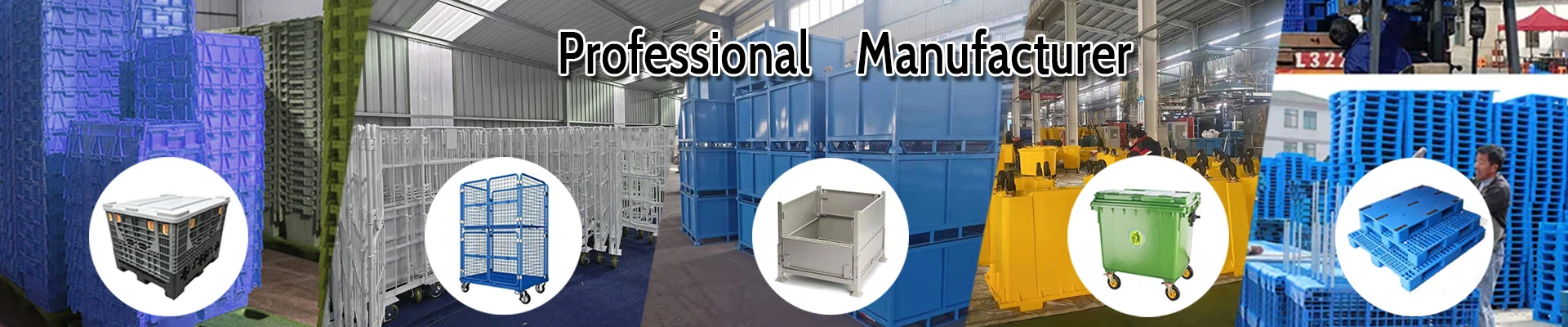
Our pallet boxes have always been a popular product, with a wide range of uses in industry, agriculture, and commerce. Below are their uses and application areas.

| Application areas | Main uses |
| Automotive and manufacturing industries | Turning and storing parts, semi-finished products, and raw materials |
| Warehousing and Logistics Industry | Standardized turnover boxes are used in conjunction with forklifts for the sorting, temporary storage, and transportation of goods. |
| Food and Beverage Industry | Packaging and transporting agricultural products, food ingredients and finished products |
| Pharmaceutical and Chemical Industries | Safe packaging and transportation of chemicals, pharmaceutical raw materials, etc. |
| Agriculture and Fisheries | Used as aquaculture containers or product packaging |
| Textile and Retail Industry | Storing and circulating raw materials or goods |

The widespread utility of plastic pallet boxes is determined by their material, which offers advantages such as resistance to acids and alkalis, impact tolerance, and easy cleaning. Additionally, they are lighter than wooden or metal boxes of the same type while having a service life approximately 10 times that of wooden boxes. They come in various structures, including integrated, modular, and foldable designs, with the foldable type significantly reducing storage volume when empty
Some customers are particularly concerned about the temperature range for pallet boxes. Now, we will compare the temperature ranges of our boxes made from copolymer PP and HDPE materials, along with their load capacity of 4 tons under normal conditions.
Simply put, HDPE material is more resistant to low temperatures, while copolymer PP material is more resistant to high temperatures.
The following table compares the key temperature parameters and performance characteristics of two materials:
| Comparison dimension | Co polymer PP material | HDPE material |
| Recommended long-term use temperature | -10 ° C to 90 ° | -40 ° C to 70 ° C |
| Low temperature brittleness temperature | About -35 ° C/-10 ° C (performance begins to decline) | About -70 ° C to -100 ° C |
| Hot deformation temperature (0.45MPa) | 90 ° C-110 ° | C 60 ° C-80 ° C |
| Melting point | 140 ° C-170 ° | C 130 ° C-135 ° C |
| Core characteristics: | Good heat resistance, strong rigidity | excellent low-temperature toughness, and impact resistance |
Detailed analysis under a load of 4 tons
At room temperature (approximately 20 ° C-30 ° C), as long as products from reputable manufacturers are selected, both types of cardboard boxes can safely carry 4 tons of cargo. But when the ambient temperature changes, the situation is different.
1. Co polymer PP cardboard box
- High temperature environment (such as prolonged exposure to sunlight, close to heat sources): This is the strength of PP. Its thermal deformation temperature is as high as around 110 ° C, so its rigidity is better maintained in environments of 50 ° C or even higher, and the risk of deformation at a full load of 4 tons is lower than that of HDPE. If your customers are in high-temperature areas or need to load freshly baked goods, PP is a more secure choice.
- Room temperature environment: The best performance can fully meet the load requirement of 4 tons.
- Low temperature environment (such as cold storage, northern winter): This is the weakness of PP. PP materials become brittle at low temperatures and their impact resistance significantly decreases. Although the brittleness temperature of PP is around -35 ° C, its toughness begins to deteriorate below 0 ° C. If a PP pallet box with a full load of 4 tons is transported in an environment of -10 ° C, the risk of brittle cracking of the box will increase sharply once it encounters bumps, collisions, or rough loading and unloading
2. HDPE cardboard box
- High temperature environment: Special attention is needed. The recommended operating temperature for HDPE is usually not more than 70 ° C. Under sustained high temperatures, the stiffness of HDPE will decrease and the material will become softer. If fully loaded with 4 tons of cargo in an environment above 50 ° C for a long time, the bottom of the box may deform or creep, affecting the insertion and removal of forks and the service life.
- Room temperature environment: Excellent performance, with toughness and rigidity sufficient to handle a load of 4 tons.
- Low temperature environment: This is the absolute advantage area of HDPE. HDPE can withstand low temperatures of -40 ° C or even lower, and still maintain good toughness at this temperature. For customers who need to frequently enter and exit cold storage or use outdoors in extremely cold areas, HDPE material is the best choice to ensure safety and prevent the box from freezing and cracking.
HDPE, with its excellent low-temperature resistance and toughness, is the only safe choice for cold storage applications.
Core precautions for using cold storage
Even if the HDPE material is selected correctly and used with a full load of 4 tons in a cold storage, the following operating points need to be strictly followed to ensure safety and extend product life:
The carrying capacity will shrink
Plastic will become hard and brittle at low temperatures, and its actual carrying capacity will significantly decrease. Therefore, although it can carry 4 tons at room temperature, it is recommended to reduce the load appropriately in the cold storage, reserve a safety margin, and avoid operating at full capacity.
Handle with care
this is the most crucial. Although HDPE cardboard boxes have good toughness at low temperatures, they are more "brittle" compared to their normal temperature state. It is strictly prohibited to throw, drop or roughly load and unload from a high place, as any severe impact may cause the box to crack.
Pay attention to anti slip
The surface inside the cold storage is prone to frosting or freezing, causing the box and goods to be very slippery. Be extra careful when handling, and take anti slip measures if necessary, such as using a forklift with anti slip pads.
Avoid sudden cooling and heating
If the pallet box needs to be frequently entered and exited from the cold storage, extreme temperature differences will accelerate material aging. If conditions permit, setting up a buffer zone when entering and exiting the warehouse to allow the boxes to transition at an intermediate temperature can effectively extend their service life
I would like to directly say to my clients: 'For cold storage use, we strongly recommend that you choose HDPE cardboard boxes.'. It can ensure structural safety and impact resistance when fully loaded with 4 tons of cargo in low temperature environments of minus 30 to 40 degrees Celsius. At the same time, please remind the on-site operators to handle the cold storage with care and reduce the load appropriately for safety


