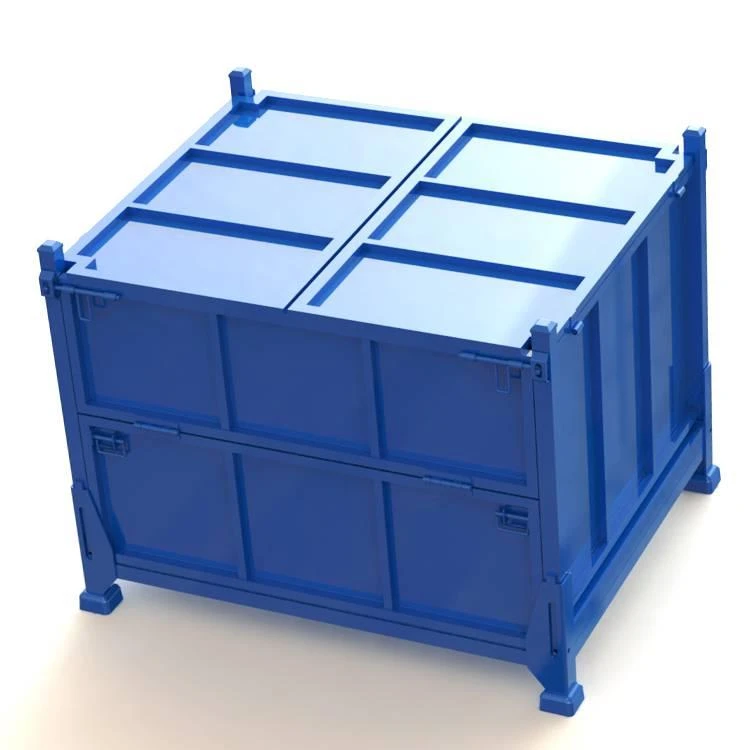
In the realm of heavy-duty logistics equipment, collapsible containers have long presented a technical challenge. Customers desire collapsibility because the cost of returning empty containers is prohibitively high-a fixed-structure container occupies its full volume even when empty, meaning the cost of transporting a hundred empty containers is nearly the same as transporting a hundred fully loaded ones. Customers require heavy-load capabilities because the cargo-such as mined ore, rubber blocks, or metal castings-is genuinely heavy, often exceeding several tons per container. Combining these two requirements puts our factory's material engineering, structural design, and manufacturing processes to the ultimate test.
Our heavy-duty collapsible container series was created specifically to meet this challenge. You can view the full specifications for these containers at https://www.plasticpalletssales.com/steel-pallet-box/. They fold down for transport and can be stacked as many as five units high. When stacked that way, the container at the bottom has to support 8 tons. Those numbers aren't just ad copy-they come from materials, structure, and build quality working together.
Materials: thickness is the starting point, but placement matters more.
When people hear "heavy-duty container," many assume the answer is simply thicker steel. That's not wrong, but you can't just make every part thicker. The extra material needs to go exactly where the stress is highest. On a heavy-duty collapsible container, the base frame rails take the biggest bending loads, the corner posts handle the most compression, and the hinges and locking systems face the highest shear. Those are the areas that need extra reinforcement.
. Conversely, the central areas of the side panels bear a distributed load-which is relatively lower-allowing for optimization that maintains rigidity while saving weight.
Our approach is as follows: The chassis longitudinal beams utilize thickened channel steel or rectangular tubing, with cross-sectional heights and wall thicknesses far exceeding those of standard collapsible containers. The uprights use thickened square tubing, with wall thicknesses ranging from 3mm to 5mm depending on the load rating. Hinge mounts and locking brackets are made from steel plates over 10mm thick, welded to critical junctions on the chassis and uprights. Side and end panels are constructed from thickened steel plate, with thicknesses ranging from 2mm to 4mm based on the load capacity. Material specifications for every model are clearly listed on the product page, allowing customers to see exactly how much material is used.
Why must the materials be robust? Because load-bearing capacity is a matter of physics, not merely design. When an 8-ton load rests on the container floor, the bending moment on the chassis longitudinal beams, the compressive stress on the uprights, and the shear force on the hinges are fixed values. These forces do not vanish simply because the structural design is "clever." Reducing material thickness or cross-sectional dimensions is mechanically unfeasible. We do not attempt to "game" load ratings by using thin materials paired with complex structures; after all, the cargo-such as ore or rubber blocks-will not become lighter just because the design is ingenious.
Structure: Channeling forces along a designed path
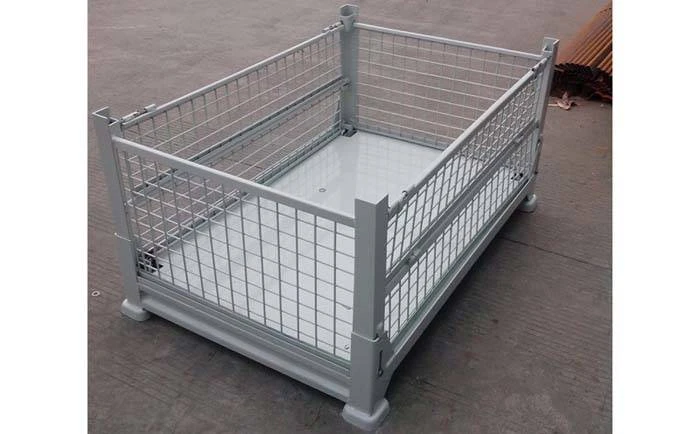
Robust materials alone are insufficient; a sound structure is required to channel forces along a predetermined path. How does force travel through a heavy-duty collapsible container? Cargo goes onto the chassis. The chassis hands it to the uprights. The uprights carry it down to the feet. The feet spread it into the ground. That path needs to stay open and solid-no breaks, no weak links.
The chassis isn't just a welded rectangle. It's built more like a truss, using long beams, cross beams, and diagonal braces. The long beams do most of the load-bearing. The cross beams link them together and help share the weight. The diagonals add torsional stiffness, so the frame doesn't twist easily. This works better than a plain rectangular frame: a concentrated load gets spread across several points instead of overloading one spot.
At the joint between the uprights and the chassis, we use thicker connection plates and full-penetration welds. The welds are ground smooth afterward, so stress doesn't concentrate in one area. Each upright also has an alignment guide on top. It lets the upper container sit exactly where it should, instead of shifting to one side. Even if the load isn't perfectly centered, the stack stays stable.
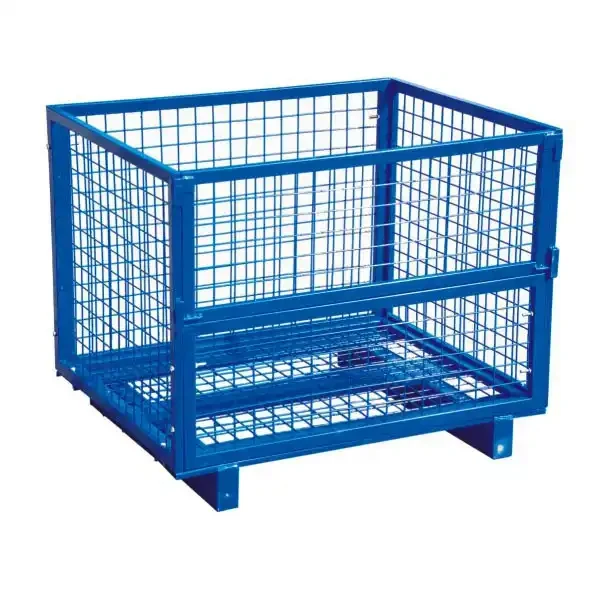
The folding mechanism represents the most challenging aspect of the structural design. The hinge pins are made of thickened solid round steel, and the hinge mounts utilize thickened steel plates; both undergo flaw detection inspections after welding. A multi-point locking design is employed; once the side panels are unfolded, load is distributed across multiple locking points-top, bottom, left, and right-preventing overload at any single point. The locking handle is ergonomically optimized for effortless operation and reliable locking. We have conducted folding durability tests: after hundreds of folding and unfolding cycles under full load, the hinges showed no deformation, the locking mechanism remained secure, and the side panels showed no outward bulging.
The design drawing decides the material and the structure. What it can't decide is whether the finished box actually holds up. That gets settled on the production line, step by step. A heavy-duty collapsible container goes through cutting, bending, welding, grinding, surface treatment, and assembly. If any step falls short, it will show up in load capacity and service life.
Welding is the part that matters most. The joints between the chassis longitudinal beams and crossbeams, between the uprights and the chassis, and between the hinge brackets and side panels all involve load-bearing welds. How well those welds are made pretty much determines how strong the container is..We utilize continuous welding performed by certified welders, strictly adhering to parameters specified in the process instructions. Post-welding, welds undergo visual inspection and, where necessary, penetrant testing to ensure the absence of cracks, porosity, or lack of fusion. Weld points are ground smooth to prevent injury to operators or damage to cargo.
Surface treatment ensures the container's durability during long-term use in harsh environments. Our heavy-duty folding containers undergo a hot-dip galvanizing process, creating a metallurgical bond between the zinc-iron alloy layer and the steel for exceptional adhesion; the sacrificial anode protection mechanism ensures the base material remains protected even if the zinc layer is scratched. The containers withstand over 480 hours of salt spray testing without showing red rust, making them suitable for environments such as mines, ports, and open-air storage yards. With our own powder coating workshop and partner hot-dip galvanizing lines, we handle surface treatment in-house rather than relying on third-party contractors, ensuring full control over delivery schedules and quality. For clients with specific aesthetic requirements, we also offer a composite finish combining hot-dip galvanizing with powder coating.
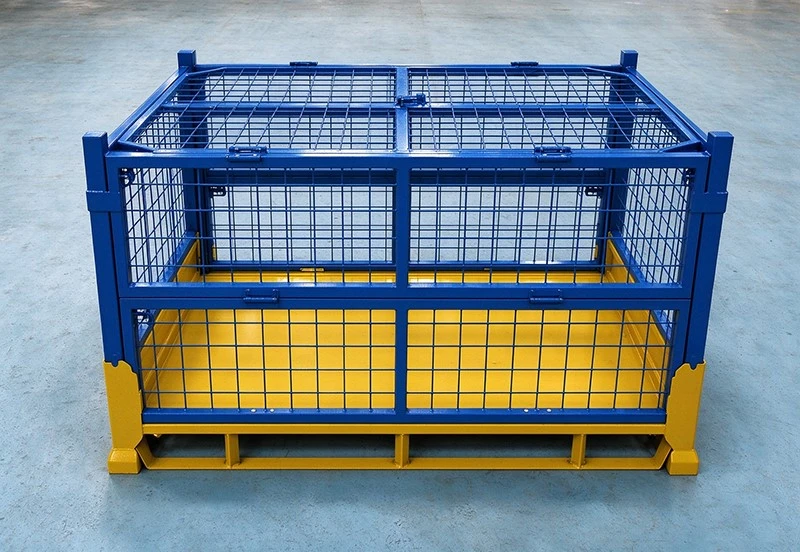
From Mines to Rubber Plants: Real-World Applications of Heavy-Duty Collapsible Boxes
Our heavy-duty collapsible boxes are already in use across various industries. At mining sites, they are used to transport ore and equipment parts; they can be stacked when fully loaded and collapsed for return transport when empty. In rubber plants, they facilitate the storage and handling of rubber blocks and products; their hot-dip galvanized finish ensures long-term, rust-free use even in humid environments. Automotive parts manufacturers use them to handle heavy castings and stamped components, where the ability to stack five units high saves significant warehouse space.
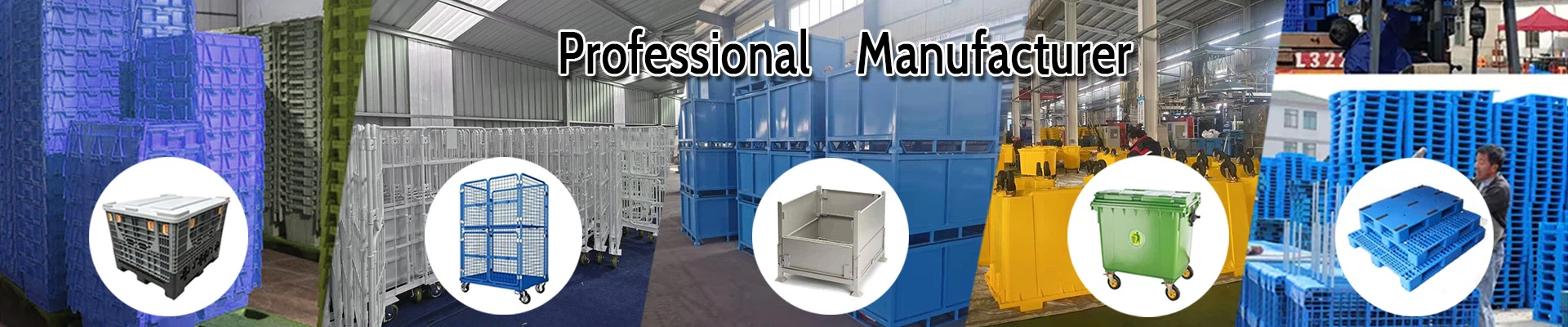
Our customers choose us for a simple reason: their loads are too heavy for standard collapsible boxes, yet the return shipping costs for fixed-wall containers make them uneconomical. Our heavy-duty collapsible boxes are among the few solutions that meet both requirements. On top of that, we've been mass-producing for years and have loaded plenty of export containers. With our big plants and solid capacity, large orders are no problem-non-folding items or collapsible bins, either way.
If you want a metal bin that folds down but can still haul serious weight, take a look at our heavy-duty collapsible range: https://www.plasticpalletssales.com/steel-pallet-box/. Just tell us what you're storing, the load per bin, how you need to stack, where it'll be used, and how it's coming back. We'll help you narrow down the best model. Mining, rubber storage, or any other heavy-duty setup-we can help at every step, from material choice and structural design to surface finishing and volume production.
You don't have to choose between collapsibility and heavy-duty performance.